
Baskerville Punch is an open-source font family that aims to bring Baskerville’s types back to life, based on the original punches cut between 1750 and 1775, which are preserved in Cambridge today.
The workshops
The project began with three intensive workshops led by the designers on master’s programmes in type design across Europe. These took place in 2025 at the University of Reading (UK), the ANRT in Nancy (France), and ECAL in Lausanne (Switzerland).
Each workshop focused on a different optical size of Baskerville’s types: Great Primer (16 pt) in Reading; two display sizes, Two-Line English and Two-Line Double Pica (approximately 28 and 40 pt), in Nancy; and two smaller text sizes, Pica and Brevier (12 and 8 pt), in Lausanne.
Using images of the original punches and enlarged reproductions of Baskerville’s printed specimens as references, the students first analysed and sketched the letterforms before developing them digitally. Each workshop consisted of an intensive week of design, with regular critiques, discussions, and demonstrations. By the end of each week, the groups had completed a full set of uppercase and lowercase characters.
This work formed the basis of the Baskerville Punch font family. Working with the students allowed the designers to become intimately familiar with the original sources, and develop a deeper understanding of Baskerville’s design choices.
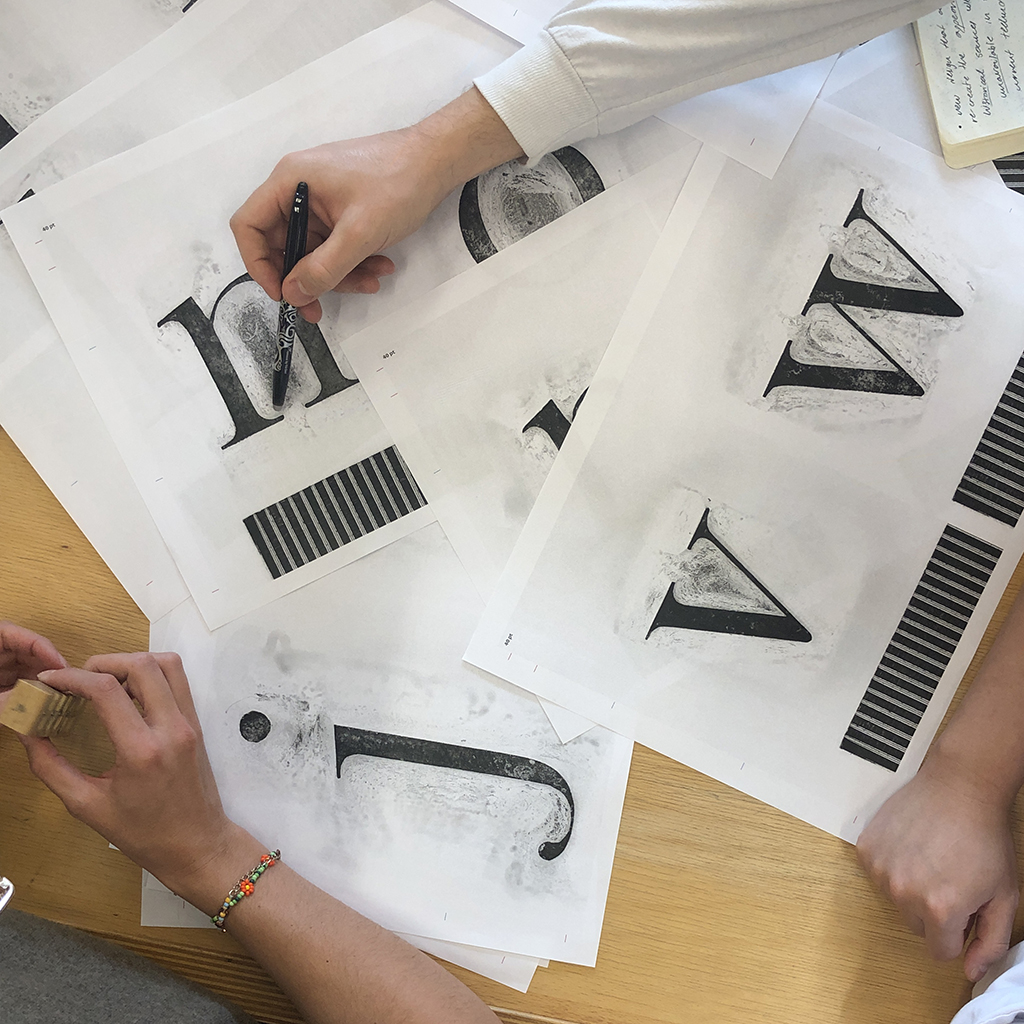
Workshop participants
Chae Ahn, Lothaire Arnoux, Saliù Baldé, Vrinda Bhageria, Kriszta Bolcsik, Claudio Bolzonello, Louna Bourdon, Mickael Bourguer, Orlando Brunner, Yaprak Buse Çağlar, Elena Calò, Arnab Chakraborty, Roy Chan, Dohee Lee, Li Fangzheng, Ian Farnam, Meryem Fekhari, Gabriela Simon Flores, Julian Jaffé, Franco Jonas, Yannick de Kalbermatten, Phil Kim, Jonny Knight, Fred La Barre, Coline Malaman, Nunzio Mazzaferro, Tanguy Merkt, Marine Monseux, Beatriz Moreira Rigolon, Mara Nolze, Diego Steiner, Jacob Tegel, Sean Tien, Myrthe Van Rompaey, Nik Votsis, Friederike Wagner, Joke De Winter, Saba Yousef.
The design
John Baskerville’s types incorporated the main features of the popular calligraphic style of his time: the English round hand. Representing a turning point in the history of letterforms, they were admired by many European printers and punchcutters, including Bodoni and the Didots, who built on Baskerville’s aesthetic in developing the ‘modern type’.
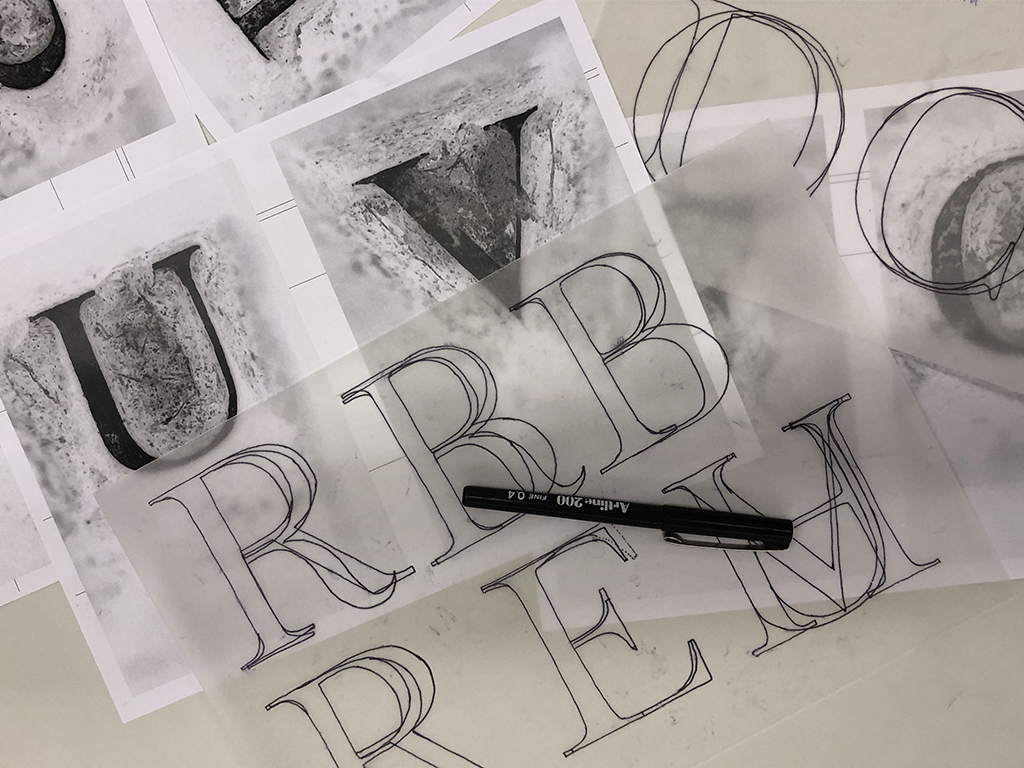
Material produced during the analysis of the original sources
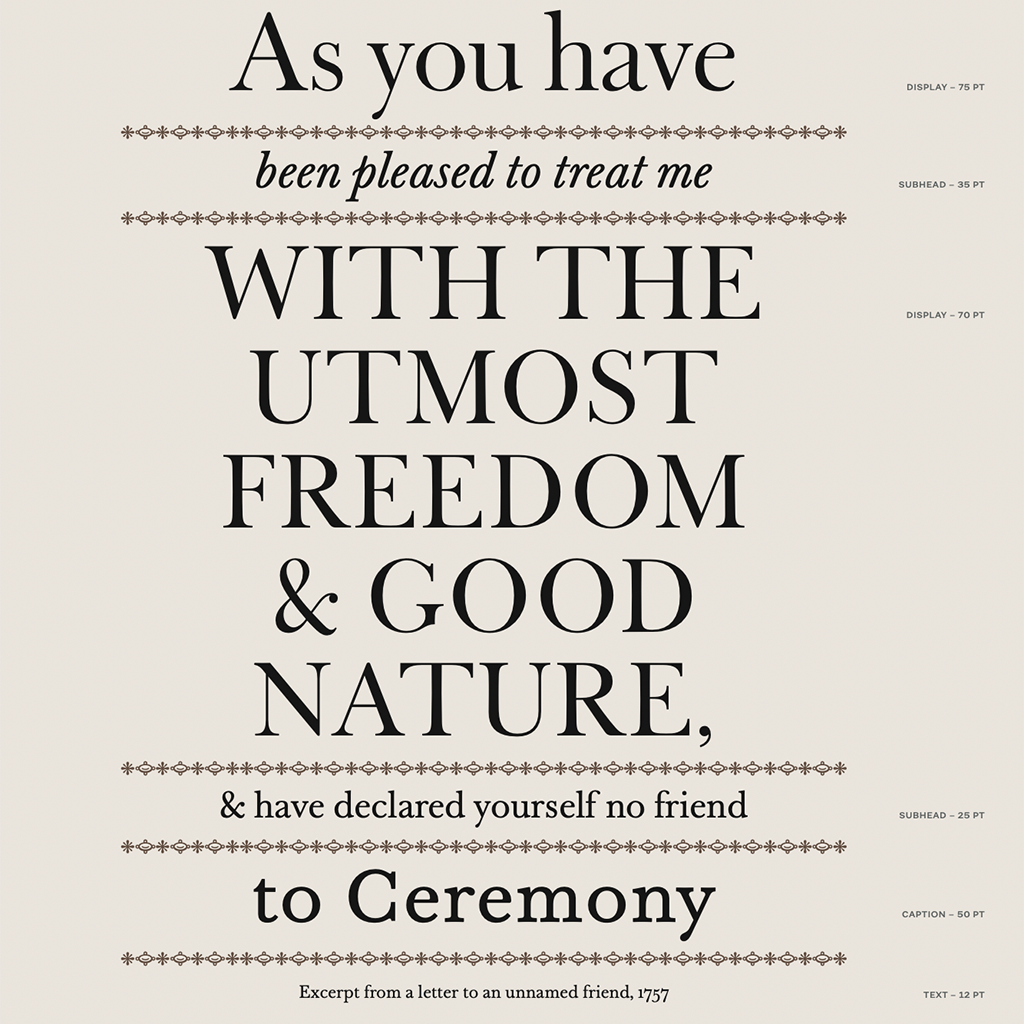
A composition of the type in different optical variations, at different sizes
Download the fonts
Baskerville Punch font family: download. The fonts are distributed with an OFL license.