
As part of the Small Performances Project the development team at Cambridge University Library has been able to introduce Reflectance Transformation Imaging (RTI) views to selected items in the Cambridge Digital Library (CUDL).
In addition to the high resolution deep-zoom IIIF images, you can now explore items from the Baskerville Punches collection by moving the light source, enabling you to see the surface detail of the punches in a highly interactive, engaging way.
A New Way to Explore: RTI in Action
Background
The Cambridge Digital Library (CUDL) presents the University’s collections — from medieval manuscripts to scientific instruments — through high-quality digital imaging and detailed metadata.
We are committed to using open source components. The Cambridge Digital Library is built using the Cambridge Digital Collections Platform (CDCP) that uses OpenSeadragon for IIIF image presentation and now OpenLIME for RTI image presentation. Our source data is encoded in TEI XML, a best-practice format in digital humanities that supports interoperability and the long-term reuse of materials. Our encoding guidelines allow surfaces to have both IIIF zoomable images and RTI images. This enables the platform offer users the ability to move easily between formats and explore items in new ways using a simple, familiar display.
RTI enables interactive relighting to reveal fine surface details not visible in standard photography, extending the viewer’s capabilities and providing a flexible foundation for future display formats.
Capturing Imaging Information in TEI
In the Cambridge Digital Library, a digital Item (book, manuscript, object) is defined by its TEI source file, which encodes metadata, structure, and links to image data.
Our encoding practices allow our TEI source file to reference multiple types of image representations — for example:
- A zoomable IIIF image for one page, and
- An interactive RTI view for another.
All image and metadata relationships are recorded in the TEI source data, using standard elements and attributes to describe the nature of each digital representation. This allows us to include references to both the IIIF manifest and the RTI dataset, preserving semantic clarity while staying compliant with established metadata practice.
Linking RTI Surfaces via @corresp
The innovation lies in allowing one <surface> to reference another via the @corresp attribute. In this TEI source data:
- A “proxy” <surface> element points to its parent “real” surface (e.g. corresp=”#surface123″).
- This makes it possible to group different display formats together while maintaining a logical link to the page or object they belong to.
- The transformation datasets themselves remain external, but they can now be embedded in a consistent, discoverable structure.
This means that researchers can browse an item in CUDL and seamlessly move from ordinary digital images to interactive RTI renderings, without any change in metadata style or TEI structure.
RTI Images with OpenLIME
For Reflectance Transformation Imaging, we adopted OpenLIME — an open-source, WebGL-based framework for viewing RTI, 3D, and high-resolution image data.
Our imaging workflow produces HSH-27 format RTI files (Hemispherical Harmonics with 27 coefficients), offering high-fidelity relighting performance suitable for web deployment.
The RTI viewer is initialised with a simple configuration and added dynamically to the viewer container:
const lime = new OpenLIME.Viewer('#openlime', { background: 'black' });
const layer = new OpenLIME.Layer({

layout: 'tarzoom',

type: 'rti',

url: rtiURL,

normals: false

});
lime.canvas.addLayer('RTI', layer);
OpenLIME’s built-in UIBasic component provides user controls for lighting direction, zoom, rotation, and layer management. We also added a custom “Help” dialog offering contextual guidance within the viewer interface.
The Baskerville Punches
Our first full RTI release in CUDL showcases the Baskerville Punches — a collection of eighteenth-century steel punches used by the typographer John Baskerville to create his iconic typefaces.
These tiny, precisely engraved steel punches are ideal subjects for RTI imaging. The interactive relighting reveals micro-level tool marks and engraving nuances invisible under static lighting.
Each punch has been captured in HSH-27 RTI format and presented through OpenLIME, providing a detailed and tactile sense of Baskerville’s craftsmanship. This dataset serves as both a technical demonstration and a research resource, showing how surface imaging can transform the study of material culture.
Demonstration: RTI in Action
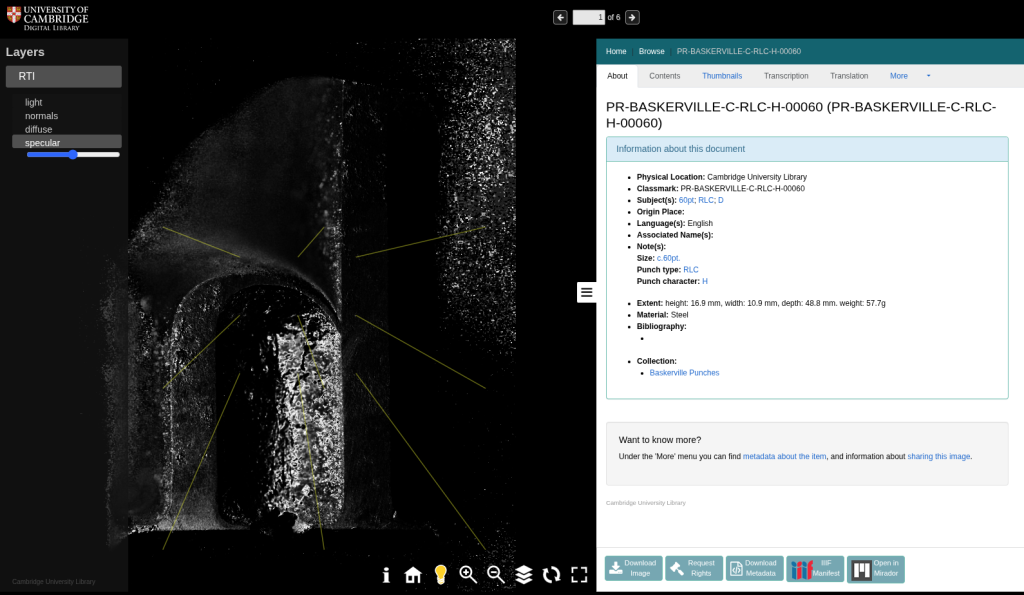
Below is a demonstration of the RTI viewer in the Cambridge Digital Library, using the Baskerville Punch for the letter “h” as an example. The viewer allows users to move the light source, switch between surface representations, and adjust specular and diffuse reflection parameters in real time.
Light View: Interactive relighting using the full RTI data.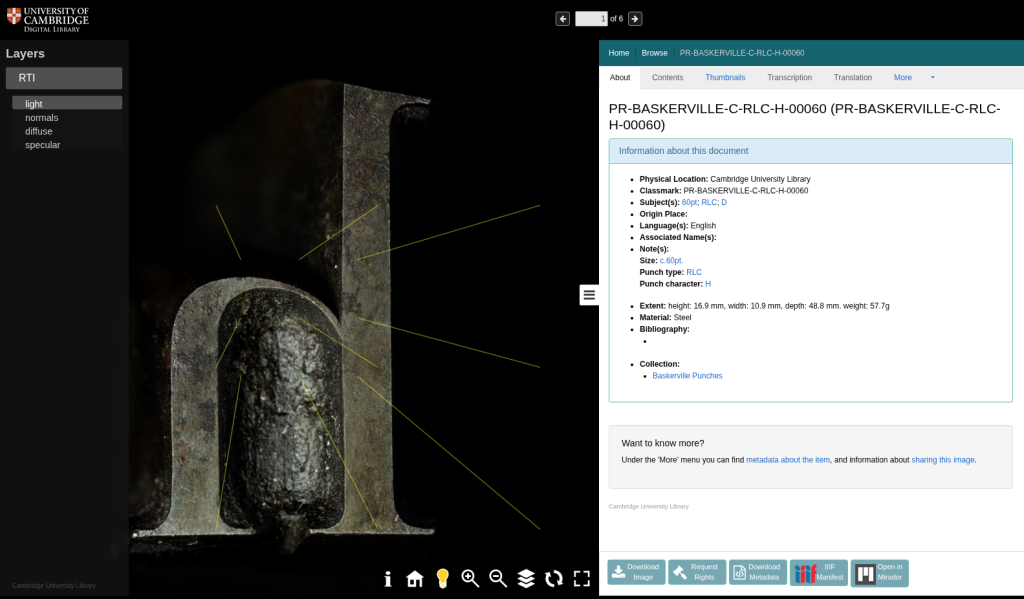
Specular View: Interactive relighting emphasising reflective highlights.
Normals View: False-colour map of surface orientation.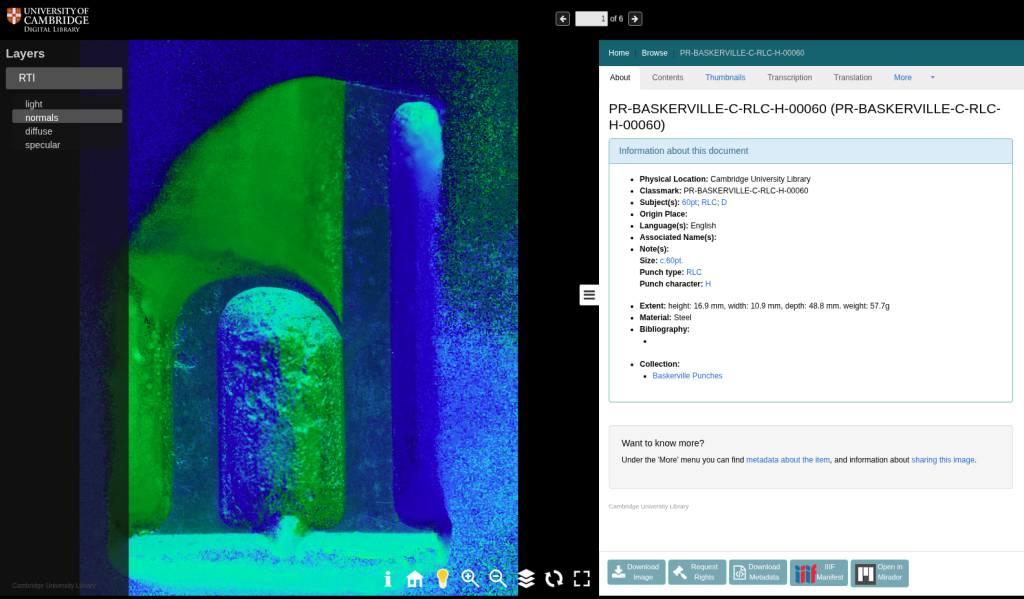
Diffuse View: Interactive relighting with surface reflectance simplified.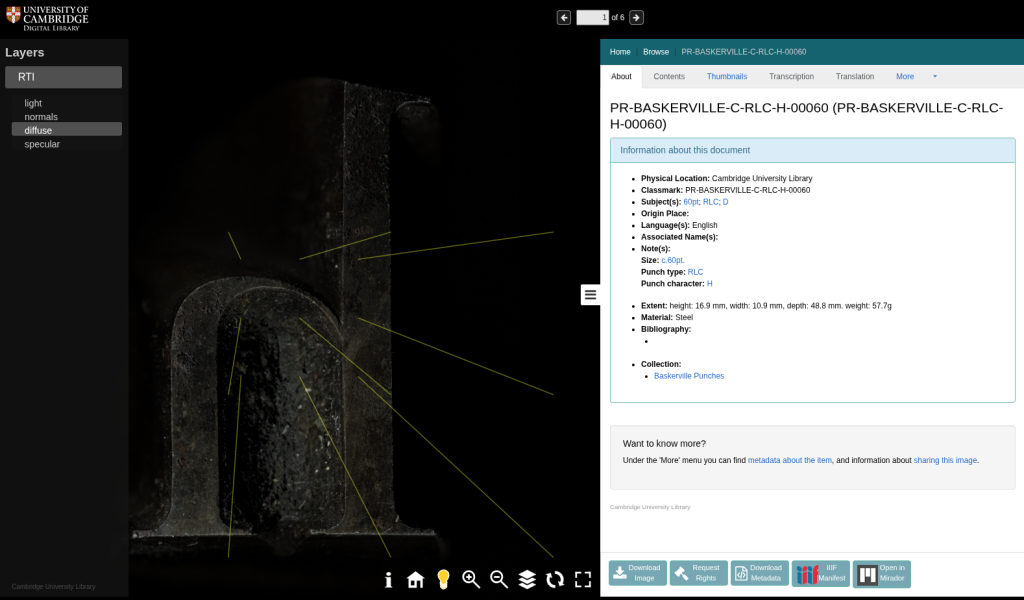
Conclusion
The enhanced viewer framework in the Cambridge Digital Library reflects an ongoing effort to explore new ways of presenting digital collections while keeping the experience straightforward and reliable. By enabling an RTI view within an open, modular platform and using TEI metadata consistently, we’re able to offer researchers more flexible and engaging ways to study artefacts, while maintaining data integrity and interoperability.
The Baskerville Punches provide the first example of this, showing how interactive relighting can reveal fine details that static images can’t. Developed as part of the Cambridge Digital Collections Platform (CDCP), this work builds on open-source collaboration and shared standards, helping to support not only CUDL but also the wider cultural-heritage community. Looking ahead, this framework lays the groundwork for incorporating additional display formats, such as 3D and multispectral imaging in the future.